
Mountain biking is full of challenges and there is always a risk involved. Be aware of the consequences when taking risks.
That is to say if you're attempting a tricky section and not sure if you can make it, what happens if you fall? If you are just going to fall into bushes then it might be a risk worth taking.
If you're going to fall down a steep gulley, it's a risk not worth taking. Sounds obvious but these split decisions have to be made constantly.
Another thing worth considering is helicopters cannot fly in low visibilty and will not be able to come out to rescue you in the event of an accident. In bad weather, take fewer risks and try to stay near to a 4X4 trail where the emergency services can get a vehicle to you.
Wear a helmet. Always carry a mobile phone in case of emergency and make yourself aware of the relevant telephone numbers for emergency services (in Italy and Switzerland too if necessary).
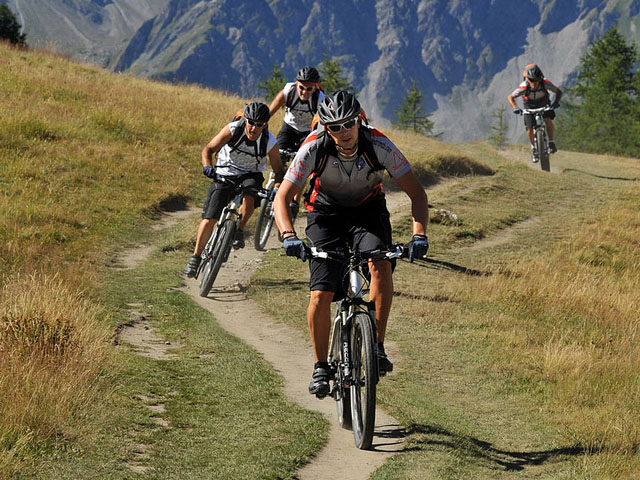
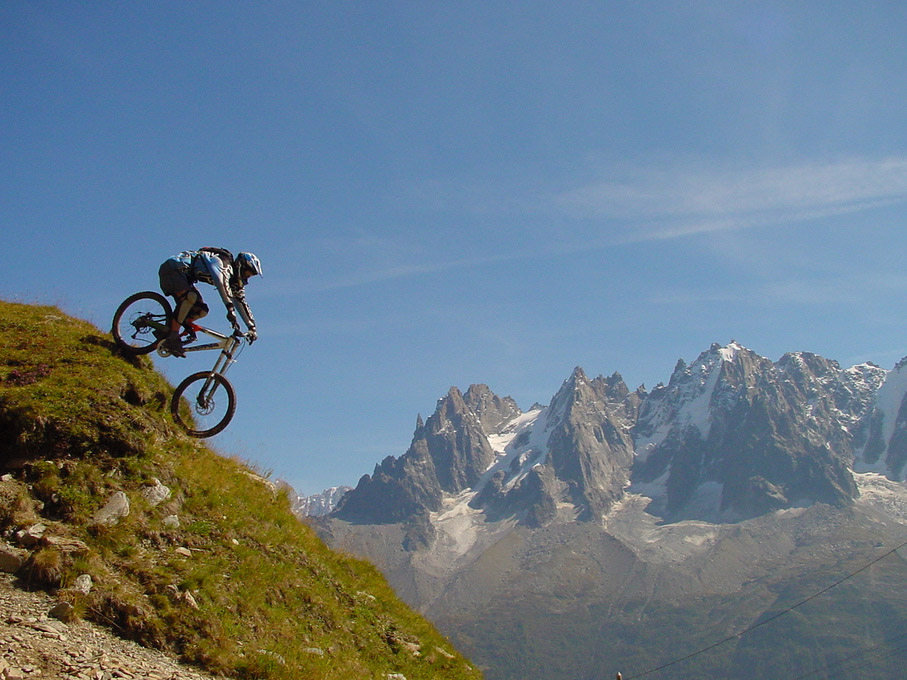
Always carry a first aid kit and be aware of how to use it.
Mountain Biking in Chamonix: Back to basics
"Is this bloke serious? Trying to give me a lesson on how to mountain bike." Don't laugh! Believe me, when the trail is a 25% slope normal rules do not apply.
Bike Choices and Preperations
Suspension: The first question we are always asked is "full sus' or hardtail?" It comes down to what you like and what you are used to do. MBMB riders are probably split about 60/40 Full sus to hardtail.
If you've never experienced alpine MTBing before, there are few things you can do to make life easier when setting up your bike.
Brakes: Make sure they are in good condition. Suprisingly brakes don't normally wear out that quick because most of the time the trails are dry. It's the mixture of sand/soil and water on the braking surfaces that causes wear. If you are planning a big ride on a rainy day, carry spare pads as you can get through a set in a day easily.
Fatigue on the hands can be painful on long descents so for more efficient braking, set your levers inboard about 3 cms and brake with just 1 finger. With your hand in it's normal position on the bars, stick out your index finger and it should be at the end of the lever and not in the middle.
Tyres: The trails are rocky in Chamonix so use fat tyres to avoid pinch flats. Keep them well inflated - 3 bar (45psi) or even 4 bar if you are a heavy rider. There are good mountain bike shops in Chamonix so don't bring loads of spares - maybe just a few bits specific to your bike. You don't need to carry loads of water. There are lots of water stops.
Switchbacks & Navigation
Riding Switchbacks on Mountain Terrain
Tight, steep switchbacks are unique to alpine riding and even the most seasoned riders find them tricky when faced by them for the first time.
Approach the switchback slowly with your weight well back (belly on saddle if it's a steep one) and your outside foot forward (left forward for RH turns and vice versa) and slightly higher than your trailing foot.
Having you outside foot forward is vitally important, it enables you to rotate you upper body making these tricky little turns a whole lot easier.
We are forever hearing people say "I can do the left handers but not the right" or vice versa. This is because you naturally ride favouring one foot forward - if this is your right foot, you will find left handers easier... get it? Get used to riding with both left and right foot forward.
As you approach the turn, run your front wheel wide and turn you head and shoulders in the direction of the turn and look for the trail about 2 metres after the turn. Your rear wheel will naturally track on the inside of the turn. If you don't think you'll make it, bail out by slipping off the back of the saddle.
It is worth noting that in the middle of the turn, you have more control you're your front brake. This is because the front wheel is turning quicker that the rear.
Navigating Gullies on a Mountain Bike
Gullies or, "renvoi d'eau", as the french like to call them, are another unique feature of alpine MTBing. NEVER moan about these obstacles. They are part of the reason the Chamonix trails are always in such good condition. They keep rainwater - the worst cause of trail erosion - off the trail.
If gullies are new to you, take them slow at first. If you ride at them fast with no technique, they'll throw you over the bars. It's all about weight distribution.
- As you approach the gulley, preload (compress) your suspension.
- Then throw your weight back and pull on the bars to unweight and lift slightly the front wheel
- As your back wheel hits the gulley, absorb the impact with your legs.
Climbing & Descending
Climbing an Uphill Trail on a Mountain Bike
Basic rules: low centre of gravity and pedal evenly and steadily. The climbs are long and often steep in Chamonix and there are tips you can use to help conquer them.
On the steep or technical stuff we often hear riders say "If I put my weight over the front I spin out and if I put my weight over the back I wheelie". It's a compromise.
Get your weight slightly back on the seat but drop your chest in towards the bars to lower your centre of gravity - even dropping your elbows helps (see image below).
And always stay seated. Think about delivering the power to the pedals evenly - avoid stabbing at the pedals which will cause you to spin out.
As your technique improves and you are able to climb steeper and steeper climbs, you will need to shift your weight forward onto the nose of the seat to stop the front lifting.
Descending a Downhill Trail on a Mountain Bike
Weight back and brake evenly. The steeper or more technical the descent, the further back your weight should be - to the point where on really steep stuff, your stomach should be on the saddle.
Some people avoid using the front brake on steep descents for fear of going over the bars, but truth is, it's safe and effective if your weight is correct.
Get used to riding steep stuff with your belly on the saddle. It's the safest way. If your doing a really tough section and it all goes wrong and you need to bail out, just unclip and step off the back of the bike. Trying to dismount astride the top tube on steep stuff is not the way to go.
On long, fast descents make sure you brake evenly front and back.
If you overuse either, it will overheat and potentially fail.
If you use vee brakes, feel the rims at the end of a long descent and if you are braking correctly, they should be the same temperature (don't try this with disc brakes, you'll burn yourself).
Mounting on Steep Terrain
Getting On: Up hill
- When getting on the bike on a steep incline, you need to be seated before you start pedaling. So get in the saddle with your brakes on (put a foot on a rock or on the bank if you can't reach the floor) and get into your normal climbing position with your centre of gravity low
- Put a bit of pressure on the pedal so you can gently release the brakes
- As smoothly as possible put your foot back on the pedal and start to pedal.
Steep Terrain: Up Hill & Down Hill
Getting On: Down Hill
- Getting back on the bike on a steep decline is tricky too. Stand behind the bike with your legs either side of the rear wheel.
- Lean forward, grab the bars, apply both brakes and rest your belly on the saddle.
- Clip in your best foot (downhill one if you're on a cambered trail). Put more weight on your belly until you can lift the other foot. As you lift the other foot, release the brakes slightly to start rolling.
- Get the other foot on the pedal then bring your body up into normal downhill position once your foot is clipped in.